How much should we spend on security?
Link to section: How much should we spend on security?Every security budget faces the same question from leadership: prove it's worth it. This guide gives you the real-world breach data from the IBM Cost of a Data Breach Report 2024 and a concrete ROI framework to make the case. So the next time someone asks "How much should we spend on security?", you answer with numbers, not guesses.
- Flat-percentage budgets (5-15% of IT spend) ignore your actual risk exposure, leaving dangerous funding gaps.
- The average data breach cost $4.88M globally and $9.36M in the U.S. in IBM's 2024 study of 604 breached organizations.
- Risk-based budgeting using Annual Loss Expectancy (ALE) reframes security spending as measurable ROI, not a cost center.
- Organizations that used security AI and automation extensively paid $2.22M less per breach than those that used none.
- A severe security skills shortage went with breaches costing $1.76M more ($5.74M against $3.98M) than little or no shortage.
The Security Spending Gap: Where Most Budgets Get It Wrong
Link to section: The Security Spending Gap: Where Most Budgets Get It WrongMost organizations set their security budget using one of two flawed methods: a flat percentage of IT spend (typically 5-15%) or peer benchmarking ("Company X spends $2M, so we should too"). Neither accounts for your actual risk exposure. The result is a spending gap, either dangerously underfunded or wastefully over-allocated in the wrong areas.
The IBM 2024 data makes this gap visible. Consider a mid-market company with 1,000 employees:
| Approach | Method | Budget | Context |
|---|---|---|---|
| Typical (flat %) | 10% of IT budget | $800K | Based on industry averages, no risk context |
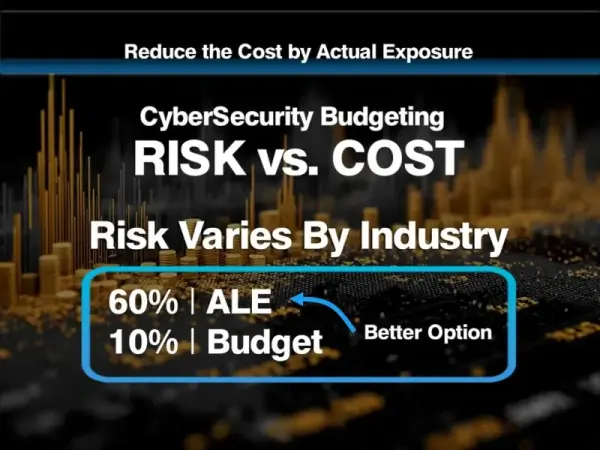
| Risk-based | Breach cost: $4.88M, one a year | $1.2M | Targets 60% ALE reduction, 144% ROI on spend |
The flat-percentage approach leaves this company $400K short of what the data says they need. That gap translates directly into unmitigated risk: slower incident response, unpatched systems, and no budget for the breach that IBM puts at $4.88M on average.
The $400K difference isn't overspending. It's the gap between guessing and knowing.
A risk-based budget starts with your actual threat exposure, then works backward to determine what controls are worth funding. The sections below give you the benchmark data to build that case. (New to ALE and the formula behind it? See our Annual Loss Expectancy resource page for the fundamentals.)
IBM Cost of a Data Breach 2024: The Numbers
Link to section: IBM Cost of a Data Breach 2024: The NumbersIBM's annual report studied 604 organizations breached between March 2023 and February 2024, across 16 countries and regions and 17 industries. Ponemon Institute interviewed 3,556 people with firsthand knowledge of those breaches and costed each one activity by activity, so the figures are modeled from real incidents rather than projected. The 2024 report does not break costs out by company size.
| Segment | Average Breach Cost |
|---|---|
| Global average | $4.88M |
| Financial services | $6.08M |
| Healthcare | $9.77M |
| U.S. average | $9.36M |
For scale: Equifax's 2017 breach exposed the personal information of 147 million people, and its settlement set aside up to $425 million for them. Target's 2013 breach reached as many as 110 million customers. Breaches that size sit outside the averages above: IBM's 2024 figures cover breaches of 2,100 to 113,000 records and study mega breaches separately, so the typical case is what the table shows.
Mapping Benchmarks to Your Budget
Link to section: Mapping Benchmarks to Your BudgetHere's where most CISOs go wrong: they present security budgets as a cost center instead of a risk reduction function. ALE reframes the conversation into a cost-benefit analysis with teeth. The FAIR framework provides a structured methodology for exactly this kind of quantitative analysis.
ALE is the expected monetary loss from a specific threat over one year. It's calculated as: ALE = Single Loss Expectancy (SLE) x Annualized Rate of Occurrence (ARO). In plain English: how much a breach costs you, multiplied by how often you expect it to happen. This is the number that turns "we need more security budget" into "here's the ROI."
Example: Mid-Market Company (1,000 employees)
Link to section: Example: Mid-Market Company (1,000 employees)Using the IBM data:
- ALE baseline: $4.88M (IBM's 2024 global average as the SLE, assuming one breach a year, ARO = 1)
- Current security budget: $1.2M (15% of the $8M IT budget in the table above)
- Security controls reduce ALE by an estimated 60%: $2.93M reduction
- Net ROI: $2.93M - $1.2M = $1.73M in avoided losses
That's not a cost. That's a 144% return on investment, and it rests on the ARO. At a 25% chance of a breach a year the ALE is $1.22M, a 60% cut saves $0.73M, and the same $1.2M budget does not pay for itself on breach losses alone. Defend the ARO before you present the ROI.
Example: Small Business (200 employees)
Link to section: Example: Small Business (200 employees)- ALE baseline: $1.22M (the same $4.88M SLE at a 25% chance a year)
- Security budget: $250K
- Controls reduce ALE by 40%: $488K reduction
- Net ROI: $488K - $250K = $238K in avoided losses
Even modest security programs deliver significant returns when measured against real breach costs. CISA's free resources can help small organizations get started without a large budget.
| Metric | Mid-Market (1,000 emp.) | Small Business (200 emp.) |
|---|---|---|
| ALE Baseline | $4.88M (ARO 1) | $1.22M (ARO 0.25) |
| Security Budget | $1.20M | $0.25M |
| ALE Reduction | -$2.93M (60%) | -$0.49M (40%) |
| Net ROI | 144% | 95% |
| Avoided Losses | $1.73M | $0.24M |
The ROI moves with the ARO and the reduction you claim far more than with company size, so those are the two numbers a CFO will question first.
What Does a Cybersecurity Risk Assessment Cost?
Link to section: What Does a Cybersecurity Risk Assessment Cost?A cybersecurity risk assessment costs $0 if you run a free government tool yourself, and a quoted price if you hire someone, because the firms that do this work for small businesses almost never publish one. Four different jobs get sold under the same name, so the IT risk assessment pricing below is split by what you are buying, with prices checked on 2026-10-15.
| Engagement | Published price | What you get, and the source |
|---|---|---|
| Self-assessment | $0 | CISA's Cyber Security Evaluation Tool (CSET), a free desktop app that walks you through a standard question set. Nobody checks your answers but you. |
| External vulnerability scan (eligible organizations) | $0 | CISA Cyber Hygiene scans internet-facing addresses weekly and public web apps monthly. Open to government bodies and critical infrastructure organizations, and it never looks inside your network. |
| Vulnerability scanner you run | $4,790 a year (USD) | A Nessus Professional licence. You run the scans and fix what they find; the licence includes neither. |
| External risk assessment | Quote required | A consultant reviews your systems and policies against a framework such as NIST SP 800-30 and writes up the risks. No comparable public price exists. |
| Penetration test | Quote required | A tester tries to break in and reports how far they got. Priced by scope and hours; no comparable public price exists. |
A vulnerability scan lists known weaknesses. A risk assessment ranks them by what they would cost you, which is the ALE number from the section above. A penetration test proves whether one of them can be used. Buying one does not get you the other two.
Example: Year One for a 20-Person Office
Link to section: Example: Year One for a 20-Person OfficeRun CSET first; it costs an afternoon. If someone on staff will read and act on scan results, a Nessus Professional licence adds $4,790. Ask for an outside assessment once a customer, insurer, or regulator wants an independent review, and ask every quote for its hours and scope so you can compare them line by line. Put the result next to your ALE: an assessment is worth buying when it changes which control you fund first.
How we priced this: on 2026-10-15 we read each price from the page linked in its row. The two consultant rows say "quote required" because we found no published small-business price to put there.
Holding a quote and unsure what it covers? Send it to us and we will tell you what is in it and what is missing.
The Budget Justification Framework
Link to section: The Budget Justification FrameworkWhen presenting to the board, use this playbook and structure the argument in three parts:
- Baseline risk: "Our ALE, based on industry benchmarks for our size and sector, is approximately $X million per year."
- Control effectiveness: "Our current security program, aligned with the CIS Controls and the NIST Cybersecurity Framework, reduces this by Y%, saving $Z million annually."
- Proposed investment: "This additional $W investment targets [specific threat category] and is projected to reduce ALE by a further $V, delivering a [percentage] ROI."
Every line item maps to a threat, an ARO, an SLE, and a measurable ALE reduction, accountability your CFO can verify. No hand-waving. No fear-based selling. Just math. The NIST SP 800-30 risk assessment guide provides the formal methodology for documenting this analysis.
Boards don't think in CVEs or threat vectors. They think in dollars. Open with the ROI figure ("Our security program delivered 144% ROI last year"), then back into the methodology. If you lead with the ALE formula, you've already lost half the room.
Key Cost Amplifiers to Watch
Link to section: Key Cost Amplifiers to WatchThe IBM report measured 28 factors one at a time against the $4.88M average. Most move it by about $250K; the exception is AI and automation, compared across whole programs:
| Factor | Impact on Breach Cost | Category |
|---|---|---|
| Security AI and automation, used extensively (against none) | -$2.22M | Cost reducer |
| Employee training | -$258,629 | Cost reducer |
| Incident response (IR) planning | -$248,072 | Cost reducer |
| Security system complexity | +$256,529 | Cost amplifier |
| Security skills shortage | +$251,940 | Cost amplifier |
| Noncompliance with regulations | +$237,118 | Cost amplifier |
| Migration to the cloud | +$230,979 | Cost amplifier |
Organizations that used security AI and automation extensively paid $2.22M less per breach than those that used none, the widest gap in the study. Incident response planning on its own took $248,072 off the average. Stolen credentials took the longest to identify and contain, at 292 days, the detection gap anomaly detection tooling is built to close. Understanding where attacks originate, mapped to frameworks like MITRE ATT&CK, helps prioritize which controls deliver the greatest ALE reduction.
If your budget can only cover two things, the IBM data points here: (1) security AI and automation, used extensively ($2.22M lower average breach cost than none) and (2) a documented, tested incident response plan (IR planning alone sits $248,072 below the average). IBM measured each separately, so the two figures don't add up to one saving.
Put Theory Into Practice
Link to section: Put Theory Into PracticeUnderstanding ALE in a spreadsheet is one thing. Making budget decisions under pressure, with a boss second-guessing you, a board demanding ROI, and threats escalating through all 18 phases of the Unified Kill Chain, is something else entirely.
Corporate Cyber Defense is an interactive simulation where you manage a security budget against real-world tactics, techniques, and procedures. Every decision has a measurable ALE impact, every dollar spent must be justified, and the CFO is always watching. It's built on the same IBM benchmarks discussed in this article.
Choose your role. Choose your difficulty. See if your budget strategy survives 18 phases of a coordinated attack.
Play Corporate Cyber Defense →
- Flat-percentage budgets miss the mark: Spending 10% of IT budget on security without risk context can leave you $400K+ short of what breach data says you need.
- Breach costs are not theoretical: IBM studied 604 breached organizations. The global average is $4.88M. Healthcare hits $9.77M. The U.S. average is $9.36M.
- ALE turns security into ROI: A $1.2M security budget that cuts a $4.88M annual loss exposure by 60% returns 144%, if one breach a year is the right ARO. At one in four years it doesn't pay back, so defend the ARO first.
- AI and automation is the biggest cost reducer: Extensive use went with breaches $2.22M cheaper than no use. IR planning and employee training each took about $250K off the average.
- Skills shortages raise the bill: Organizations with a severe shortage paid $1.76M more per breach than those with little or none. Budget for people, not just tools.
- Present risk, not fear: Structure board presentations as baseline risk, control effectiveness, and proposed investment. Every line item maps to a measurable ALE reduction.
Frequently Asked Questions
Link to section: Frequently Asked QuestionsWhat percentage of IT budget should go to cybersecurity?
The common answer is 5-15% of IT spend, but that's a flawed starting point. A risk-based approach is better: calculate your Annual Loss Expectancy (ALE) based on your industry, size, and threat landscape, then determine what controls reduce that exposure most cost-effectively. A healthcare company facing $9.77M in average breach costs needs a very different budget than a typical organization at $4.88M, even if their IT budgets are identical.
How do I calculate the ROI of cybersecurity spending?
Use this formula: ROI = (ALE Reduction - Security Investment) / Security Investment x 100. Start with your ALE baseline (use IBM's breach cost data for your industry and country as a benchmark). Estimate how much your security controls reduce that exposure from your own control data; this page uses 40% and 60% as illustrations. Subtract your security budget from the reduction amount. For example: $2.93M reduction minus $1.2M investment = $1.73M net savings, or 144% ROI.
What is Annual Loss Expectancy (ALE)?
ALE is the expected monetary loss from a specific risk over one year, calculated as Single Loss Expectancy (SLE) x Annualized Rate of Occurrence (ARO). SLE is how much a single incident costs. ARO is how often you expect it to happen annually. If a breach costs your company $4.88M (SLE) and you estimate a 25% chance per year (ARO = 0.25), your ALE is $1.22M. This is the number that justifies your security budget in financial terms. See our ALE resource page for a deeper dive.
How do I present a cybersecurity budget to the board?
Structure it in three parts: (1) baseline risk ("our ALE is $X million based on industry data"), (2) current control effectiveness ("our program reduces this by Y%, saving $Z million"), and (3) proposed investment ("this additional spend targets [specific threat] for a projected [percentage] ROI"). Anchor everything in the IBM breach cost data and frameworks like FAIR. Lead with the ROI number, not the threat landscape. Boards respond to returns, not fear.
What are the biggest factors that increase data breach costs?
In IBM's 2024 report, the top three amplifiers were security system complexity (+$256,529 against the $4.88M average), a security skills shortage (+$251,940) and third-party breaches (+$240,599); noncompliance with regulations added $237,118 and migration to the cloud $230,979. Stolen credentials took the longest to identify and contain, at 292 days. On the other side, extensive security AI and automation went with breaches $2.22M cheaper than none, and employee training (-$258,629) and incident response planning (-$248,072) were among the largest single reducers. Budget allocation should prioritize reducing these amplifiers and investing in proven reducers.
How much does a cybersecurity risk assessment cost for a small business?
A self-assessment with CISA's free CSET tool costs $0. A scanner you run yourself, such as Nessus Professional, lists at $4,790 a year (checked 2026-10-15). An outside risk assessment or penetration test is quoted per job; ask each quote for its hours and scope so two prices describe the same work. The cost table above splits all four.
Is a vulnerability scan the same as a risk assessment?
No. A scan lists known weaknesses on the systems it can reach. A risk assessment ranks those weaknesses by what they would cost your business and says which to fix first. A penetration test checks whether an attacker can use one. Pricing them as one package hides which of the three you are paying for.
Data sourced from the IBM Cost of a Data Breach Report 2024. IBM figures are averages from 604 breached organizations studied between March 2023 and February 2024; the worked examples are our own arithmetic on them. Individual organizational risk varies based on industry, geography, security maturity, and attack surface.