
Ask three Dallas developers to quote the same five-page site and the numbers can come back anywhere between a $750 template and a $20,000 custom build, and every one of them is a straight answer. The spread is not a pricing problem. It is three different answers to a choice the quotes never spell out: save now and pay for it later, or invest once in a foundation that can grow with the business.
The lesson from my side of the table, building for businesses around the metroplex from Plano, comes in two parts: the five questions that settle that choice before you compare a single quote, and what 17 scans from Texas addresses through my own scanner told me about the sites Dallas owners are starting from.
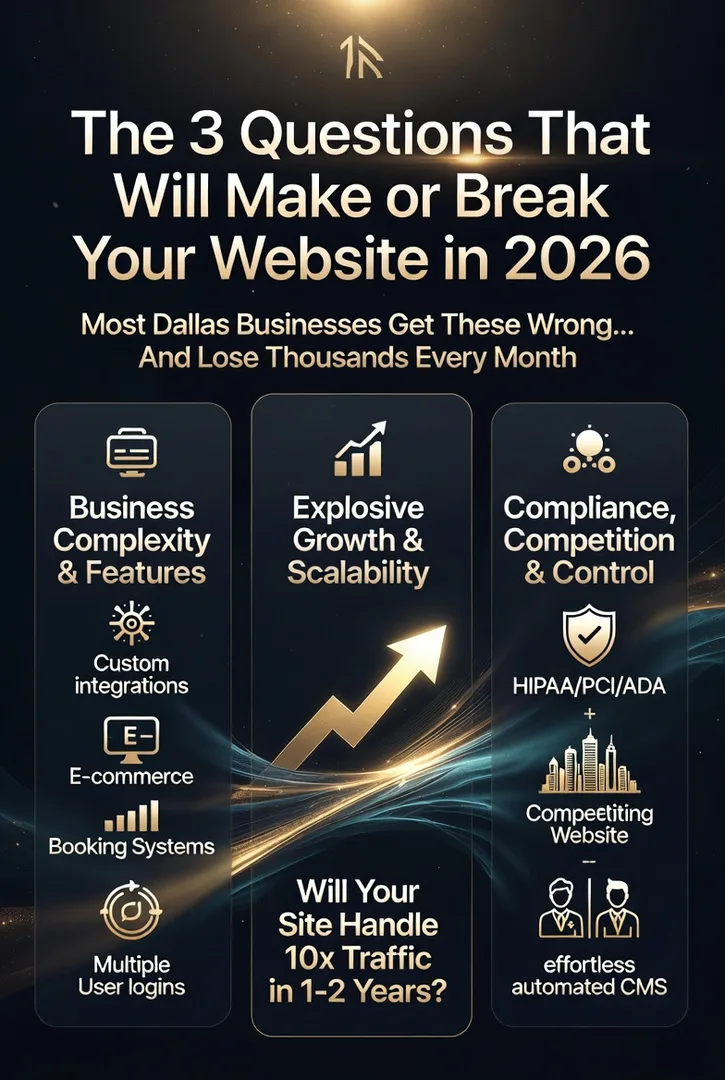
| Question | Why it matters | Points toward |
|---|---|---|
| How complex is the business online? Logins, bookings, e-commerce, integrations? | Separates a website from a web application | Custom build if yes; template or boutique if no |
| How fast will it grow in the next two years? | A platform that cannot scale forces a second rebuild | Invest once if growth is planned; save now if it is a test |
| Does the industry carry rules? HIPAA, PCI, ADA? | Compliance decides hosting, forms and security before design | A developer who has built in that industry |
| How crowded is the market in Dallas search results? | Sets how much of the budget goes to SEO and conversion | Local SEO capability on the quote, not as an add-on |
| Who updates the site after launch? | Decides between a DIY CMS and a managed service | Support terms in writing before you sign |
Those five answers remove most of the guesswork, and they turn a stack of quotes into one decision. The accordions in the next block match each answer to a build approach and to the compliance load your industry carries.
Development Approaches by Business StageFrom a pre-revenue idea to a multi-location company, matched to the right kind of builder.
| Business stage | Approach that fits | What the build has to get right |
|---|---|---|
| Pre-revenue, testing an idea | DIY platform such as Squarespace or Wix | Speed to market, low commitment, easy to walk away from |
| Established small business | Freelancer or boutique agency | Brand credibility, local SEO, a mobile score agreed in writing |
| Growth stage | Boutique or mid-tier agency | Custom functionality, CRM integration, analytics that answer questions |
| Enterprise or multi-location | Full-service agency | Scalability, compliance, integration with the systems already in place |
| E-commerce launch | Platform specialist on Shopify or WooCommerce | Payment processing, inventory, PCI compliance |
Each stage has a ceiling. Outgrowing a DIY platform is a signal that the business needs infrastructure to match its ambitions, and the expensive mistake is delaying that rebuild while a site that cannot keep up loses the conversions it was built to win.
Dallas Industry-Specific Web Development RequirementsHealthcare, finance, legal, energy, real estate and hospitality, with the compliance each one carries.
Dallas is headquarters for companies across regulated and competitive industries, and each brings requirements the developer has to understand before the first line of code.
| Industry | Key compliance | Critical features | Common pitfall |
|---|---|---|---|
| Healthcare | HIPAA, ADA | Patient portals, secure forms, appointment scheduling | Unencrypted contact forms collecting PHI |
| Financial services | PCI-DSS, SOX, GLBA | Secure client portals, document management, calculators | Third-party scripts leaking sensitive data |
| Legal | ABA ethics rules, ADA | Case intake forms, attorney bios, practice area pages | Misleading testimonials or guarantee language |
| Energy, oil and gas | NERC CIP, industry standards | Investor relations, safety documentation, project maps | Outdated compliance documentation |
| Real estate | Fair Housing Act, IDX/MLS | Property search, virtual tours, CRM integration | Slow image galleries that lose mobile buyers |
| Restaurants and hospitality | ADA, local permit display | Online ordering, reservations, menu management | PDF menus that are neither mobile-friendly nor accessible |
What Website Development Costs in Dallas
Link to section: What Website Development Costs in DallasThe average hourly rate for web design in Dallas is $96.25, and two-thirds of companies bill between $90 and $160 an hour, with freelancers starting far lower and specialist boutiques reaching $185. Those figures come from Bless Web Designs' Dallas pricing survey, updated September 2026, and the project ranges below are theirs too.
| Build | Dallas project cost | Hourly rate band | Best for |
|---|---|---|---|
| Template site | $750 to $1,500 | Freelancers, $10 to $100 | Solo operators, simple portfolios |
| Standard custom site | $2,500 to $5,000 | Most companies, $90 to $160 | Small businesses that need credibility and local search |
| E-commerce | $15,000 and up | Boutique agencies, $100 to $185 | Stores with inventory, payments and PCI scope |
| Advanced custom build | $20,000 to several hundred thousand | Up to $250 | Applications, integrations, multi-location companies |
The carrying costs surprise more owners than a hailstorm in April. Hosting, security, backups and marketing tools recur every year after the invoice is paid, so put them in the budget on day one, or watch a finished website turn into a liability one renewal at a time.
"Think of digital transformation less as a technology project to be finished than as a state of perpetual agility, always ready to evolve for whatever customers want next."
Amit Zavery, VP & Head of Platform, Google Cloud, as quoted by Google Cloud
What 17 Texas Scans Through My Scanner Told Me About Dallas Sites
Link to section: What 17 Texas Scans Through My Scanner Told Me About Dallas SitesOf the 17 mobile scans that came through my free PageSpeed scanner from Texas addresses, 13 scored a perfect 100 on the SEO category and 13 scored under 90 on performance, with a median of 87. Only 3 were under 50. That covers 9 domains between 18 August and 15 October 2026, scanned from Garland, Dallas, Allen, Euless and Fort Worth, with my own site left out.
Method: I ran a read-only query against the production
page_speed_scans table on 2026-10-22, counting mobile scans
with a stored score, no error and a Texas region on the request, and
excluded the scans of my own domain.
What that told me is where the hidden choice shows up after launch. The typical Dallas site I see is not broken. It has a title tag, a meta description and links a crawler can follow, so the checklist score is perfect, and it sits three points short of the green line on speed because the quote covered the pages and never mentioned a performance target. The habit I took from it: ask every developer you compare for the mobile performance score they will deliver, in writing, and scan the current site first so you know the number you are starting from.
I measured this on my own scanner: most of the Dallas-area sites owners bring me pass the SEO checklist and miss the speed target, so the lower quote usually costs its savings back in the rebuild that gets the last three points.
Why Dallas for Website Development
Link to section: Why Dallas for Website DevelopmentCBRE's Scoring Tech Talent 2026 report, its thirteenth, ranks Dallas-Fort Worth eighth of 50 North American markets, and sixth for AI employment with 29,840 specialized AI workers as of June 2026. The metroplex also placed 24 companies on the 2026 Fortune 500, according to the Dallas Regional Chamber, and the developers who build for those companies and for the finance, healthcare, energy and telecom businesses around them are the same pool a small business hires from.
Whether you need a five-page service site or a platform processing millions of transactions, somebody in the Dallas development ecosystem has built it before, probably for a company in your zip code. The advantage of hiring locally is the morning something breaks and you want a human in your own time zone, and I say that as the human in Plano who picks up.
Choosing the Right Dallas Web Development Partner
Link to section: Choosing the Right Dallas Web Development PartnerThree things matter more than portfolio aesthetics when you compare Dallas developers. Industry fluency leads: a developer who understands cybersecurity requirements for small businesses or has built under HIPAA and PCI-DSS saves you the post-launch retrofit. Local SEO capability comes next, because your competitors in the same search results have already paid for theirs. Post-launch support terms close the list; they decide whether the site improves over time or deteriorates like forgotten brisket.
Before you compare anyone, settle what the site is for and who writes the words. My website development overview covers the one-page brief that keeps a build from stalling, and my web development service page lays out what I need from you before the first commit.
Frequently Asked Questions
Link to section: Frequently Asked QuestionsHow long does website development take in Dallas?
Plan on 4 to 8 weeks from kickoff to launch for a basic small business site, 8 to 16 weeks for a custom build with integrations, and 12 to 24 weeks for enterprise work with compliance requirements. The biggest timeline killer is content and feedback arriving late from the client side, not development speed.
Should I hire a Dallas-based developer or go remote?
Hire local when the business sits in a regulated Dallas industry such as healthcare, finance or energy, where compliance conversations and an ongoing relationship matter. For a straightforward brochure site or a standard e-commerce build, a remote developer can deliver the same quality at a competitive rate. The five questions above tell you which case you are in.
What is the average ROI on a business website?
A $10,000 website that produces five extra sales of a $2,000 product pays for itself inside a year. For a service business, a single qualified lead that becomes a long-term client often covers the whole build. The variable that matters is not the cost of the site but how well it converts the traffic it already gets.
Do I need a custom website or will a template work?
A template works for a business with straightforward needs and a limited budget. Custom development earns its cost when you need unique functionality, strict compliance, or a conversion path built for one specific audience. Many Dallas businesses settle on a hybrid: a proven framework with custom design and targeted features layered on top.
About Website Development in Dallas
Link to section: About Website Development in Dallas- Clutch.co Dallas Web Developers: verified reviews and rankings of Dallas web development companies
- DesignRush Dallas Agencies: directory of Dallas web development agencies
- Dallas Regional Chamber: economic data, workforce statistics and business climate for DFW
- Dallas Innovates: news and analysis covering the Dallas-Fort Worth innovation economy
Dallas-Fort Worth's web development market has a mature mix of agencies, freelancers and platform specialists serving businesses from startup to Fortune 500, and the scan scores above come from Lighthouse, the open-source tool Google maintains for Chrome.
Sources: Bless Web Designs, Dallas pricing (September 2026), CBRE Scoring Tech Talent 2026, Dallas Innovates on the 2026 Fortune 500, Google Cloud (Amit Zavery), Dallas Regional Chamber