The Education Threat Matrix: Where K-12 and Higher Ed Diverge
Education cybersecurity splits into two distinct battlefields. K-12 districts and universities both carry targets, yet their attack surfaces, threat actors, and compliance obligations barely overlap. The Education Threat Matrix below maps the critical differences, because the playbook for defending a second-grade classroom looks nothing like the one protecting a research university's intellectual property.
| Dimension | K-12 Schools | Higher Education |
|---|
| Primary target data | Student PII, free/reduced lunch records, IEPs | Research IP, financial aid data, credential stores |
| Top attack vector | Phishing (22% of incidents) | Exploited vulnerabilities (35%) |
| Ransomware rate (2024) | 63% of organizations hit | 66% of organizations hit |
| Mean recovery cost (2025) | $2.20M | $0.90M |
| Pre-encryption stop rate | 67% in 2025 (highest of any industry, up from 14% in 2024) |
| Key compliance | FERPA, COPPA, CIPA, state laws | FERPA, GLBA (financial aid), HIPAA (health clinics) |
The numbers tell a story of progress wrapped in a warning. Sophos reports that 67% of ransomware attacks on schools were stopped before data could be encrypted in 2025, the highest success rate across all industries surveyed, up from just 14% the year before. That turnaround deserves applause. But attackers adapted: Comparitech's 2025 Education Ransomware Roundup tallied 251 attacks worldwide, exposing 3.96 million student and staff records. Even as raw attack counts held steady, data exposure climbed 27% year over year.
Credentials remain the skeleton key to education's digital front door. Verizon's 2025 Data Breach Investigations Report found that 86% of web application compromises in education involved stolen credentials, the highest rate of any sector studied. With students, faculty, adjuncts, visiting researchers, and alumni all needing network access, the credential surface area dwarfs most industries. Multi-factor authentication adoption remains uneven across districts, particularly in K-12 where personal devices outnumber managed endpoints by wide margins.
Supply chain attacks have become the sector's most efficient threat multiplier. The PowerSchool breach in December 2024 saw a 19-year-old gain access to the student information platform's support portal, exposing names, Social Security numbers, and medical alerts from districts across North America. Months later, Clop ransomware operators exploited an Oracle zero-day to breach Dartmouth, Harvard, and the University of Pennsylvania in a single campaign. When your vendor is the vulnerability, patching your own systems is not enough. This pattern mirrors the supply chain risks facing the IT sector, where one compromised provider cascades into thousands of downstream environments.
Individual district attacks are no less devastating at the local level. Western Michigan University endured a 13-day network outage in 2024 that forced class cancellations. Texas' Uvalde Consolidated ISD was hit by ransomware in September 2025, shutting down phones, security cameras, and visitor management systems for days. Cherokee County School District lost 624 gigabytes of data affecting 46,000 people. Student health records protected under HIPAA were exposed in multiple incidents, adding medical privacy violations to an already painful recovery process.
"Ransomware attacks in education don't just disrupt classrooms, they disrupt communities of students, families, and educators."
Alexandra Rose Director of CTU Threat Research, Sophos, as quoted in Sophos State of Ransomware in Education 2025
Rose's observation cuts deeper than it first appears. When a financial institution goes offline, transactions stall. When a school goes dark, children lose meals, counseling, special education services, and safe supervision all at once. The CIS MS-ISAC 2025 report documented how cyberattacks disrupted nutritional support, mental health programs, and developmental services across affected districts, turning a technical incident into a community crisis. Threat actors have noticed: they increasingly time attacks to maximize leverage, targeting enrollment periods, standardized testing windows, and payroll cycles when districts are most desperate to stay operational.
The encouraging news is that schools are getting scrappier. Districts partnering with K12 SIX and the Multi-State ISAC recovered faster and experienced less disruption. Half of K-12 providers and 59% of higher education organizations fully recovered within a week in 2025, up from just 30% the year before. Budget constraints remain real (government-funded school districts often compete for the same limited cyber budgets as municipal agencies), but the sector is proving that collaboration beats isolation when your adversary operates at industrial scale.
Top Attack Vectors in Education, 2024-2025
| Attack Vector | K-12 Share | Higher Ed Share | Trend |
|---|
| Phishing / social engineering | 22% | 15% | Stable, still the top entry point for K-12 |
| Exploited vulnerabilities | 18% | 35% | Rising, driven by unpatched web applications |
| Stolen credentials | 86% of web app compromises (Verizon DBIR 2025) | Persistent, MFA adoption uneven |
| Supply chain compromise | PowerSchool, MOVEit, Oracle zero-day campaigns | Surging, highest-impact vector by records exposed |
| DDoS attacks | Frequent (often student-initiated) | Moderate | Nuisance-level but operationally disruptive |
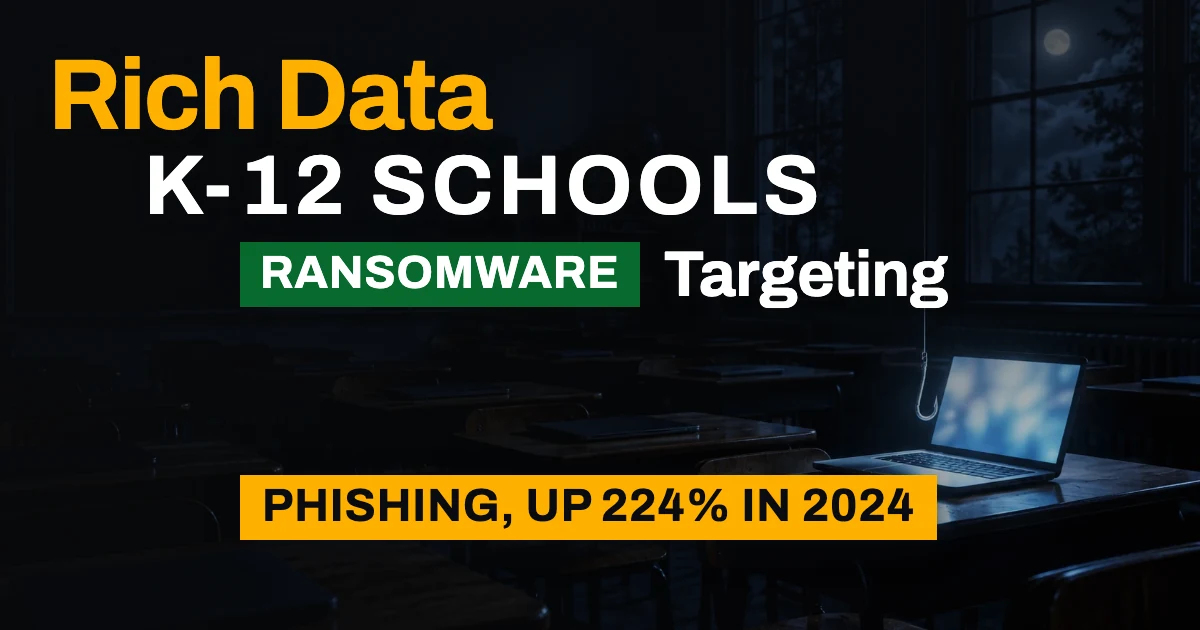
Sophos data shows phishing remains the primary root cause for K-12 incidents, while higher education's larger attack surface of internet-facing research portals and legacy applications makes exploited vulnerabilities the dominant entry point. The Verizon DBIR's credential statistic underscores why multi-factor authentication is the single highest-leverage control schools can deploy.
Education Compliance and Regulatory Landscape
| Regulation | Scope | Key Cybersecurity Requirement |
|---|
| FERPA | All institutions receiving federal funding | Reasonable safeguards for student education records; breach notification to Department of Education |
| COPPA | K-12 (students under 13) | Parental consent for data collection by third-party edtech vendors |
| CIPA | Schools and libraries receiving E-Rate funding | Internet content filtering and an internet safety policy |
| GLBA (Title V) | Higher education financial aid offices | Safeguards program for student financial information |
| State cyber laws | Varies (NY, TX, CA, and growing) | New York mandates NIST CSF alignment; Texas requires cybersecurity policy with mitigation planning |
| NIST CSF 2.0 | Voluntary (recommended by CISA) | Six functions: Identify, Protect, Detect, Respond, Recover, Govern |
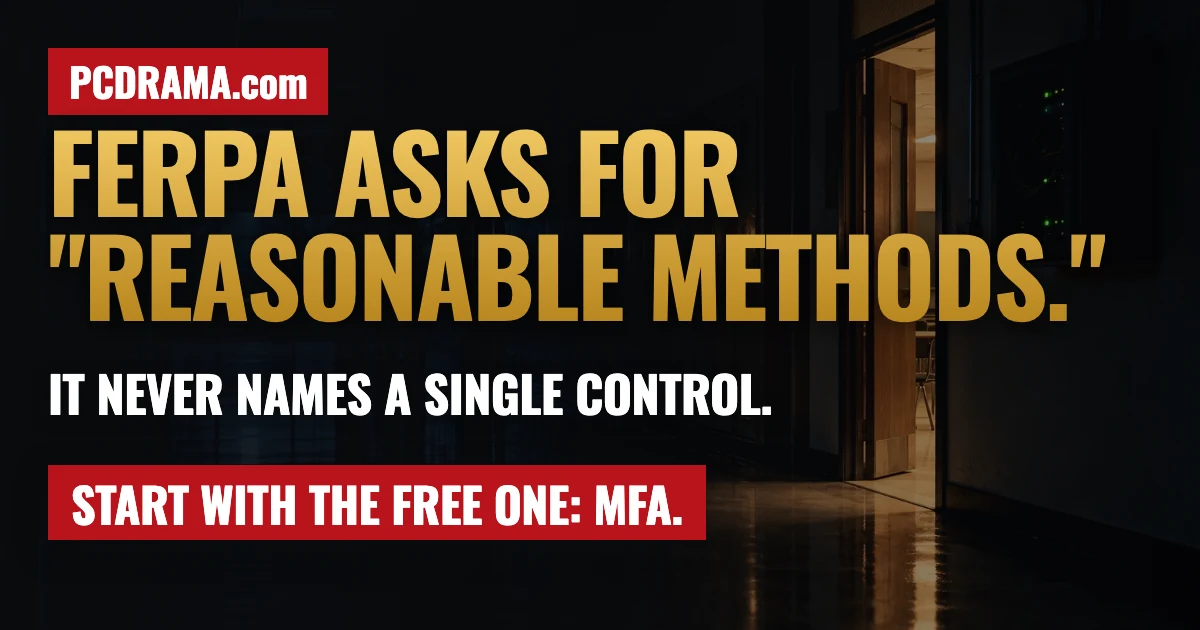
FERPA and COPPA require "reasonable" security measures but do not prescribe specific technical controls like encryption or MFA. CISA recommends aligning to the NIST Cybersecurity Framework as a practical roadmap, and several states have begun mandating framework adoption for public school districts. The K12 SIX Essentials Series provides a baseline cybersecurity standard developed by K-12 practitioners specifically for the constraints and realities of school district IT.
Frequently Asked Questions
- What are the biggest cybersecurity threats to schools in 2025?
- Phishing and ransomware remain the top threats. Sophos found that 63% of K-12 and 66% of higher education organizations were hit by ransomware in 2024, with 251 attacks worldwide in 2025. Supply chain attacks (like the PowerSchool breach) are the fastest-growing vector, exposing student data across hundreds of districts through a single compromised vendor.
- Is FERPA enough to protect student data from cyberattacks?
- FERPA requires "reasonable safeguards" but does not specify technical controls like encryption or multi-factor authentication. Security experts and the Public Interest Privacy Center have called for updating FERPA to include explicit cybersecurity requirements. CISA recommends schools align with the NIST Cybersecurity Framework to close the gap between FERPA's broad mandate and the technical defenses schools actually need.
- How much does a data breach cost a school district?
- Sophos reports mean recovery costs of $2.20M for K-12 and $0.90M for higher education in 2025, down significantly from $3.76M and $4.02M in 2024. These figures exclude long-term expenses like credit monitoring for affected students, legal fees, and the reputational damage that can follow a district for years after the initial incident.
About Education Cybersecurity
CISA calls K-12 education "the most important institution to the future prosperity and strength of the United States" and maintains a dedicated cybersecurity program for the sector. K12 SIX provides free threat intelligence and publishes the Essentials Series, a baseline cybersecurity standard developed by K-12 practitioners for K-12 practitioners.
Sources: CIS MS-ISAC 2025 K-12 Cybersecurity Report, Sophos State of Ransomware in Education 2025, Comparitech Education Ransomware Roundup 2025, CISA K-12 Cybersecurity, FBI IC3 2024 Annual Report