Fraud Detection
Select packages and get started
Category Insights
All Resources (2)
Link
Youtube-video (2)
Why Choose Us?
- Expert professionals with industry certifications
- Customized solutions for your needs
- Fast response time within 24 hours
- Competitive pricing and transparent quotes
Need help deciding?
Contact UsTrusted By
500+
Clients Served
98%
Satisfaction Rate
Secure & Confidential
About Fraud Detection
Fraud prevention and detection solutions using behavioral analytics, machine learning, and real-time monitoring. Protect against account takeover, payment fraud, and identity theft.
Pressure (or Motive) | Opportunity | Rationalization | These are the three sides to the fraud triangle.
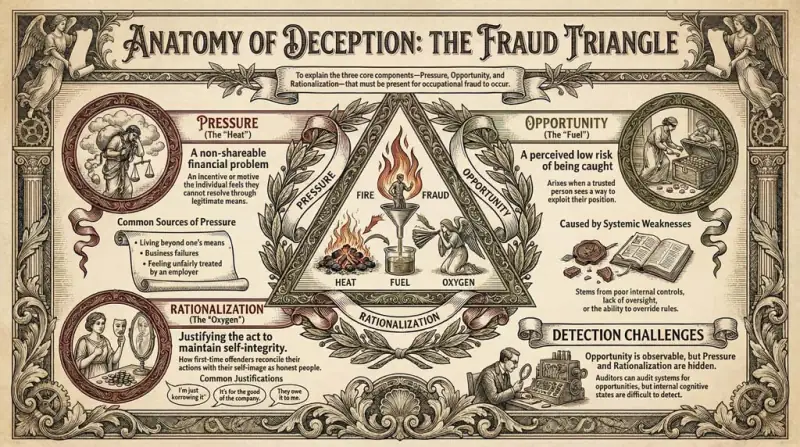
Pressure (or Motive) represents an incentive to commit fraud which is defined as a non-shareable financial problem. These are obligations that a person feels they cannot share with others or resolve through legitimate means without social or professional ruin. According to a criminologist named Donald Cressey, these problems can be categoriezed into six types, including status gaining (living beyond one's means), business reversals (uncontrollable failures), and employer-employee relations where the individual feels unfairly treated.
- Difficulty in paying back debts: Managing standard financial obligations that have become unmanageable.
- Problems resulting from personal failure: Financial crises stemming from one's own errors or shortcomings.
- Business reversals: Uncontrollable failures in business, often brought on by external forces like inflation or recession.
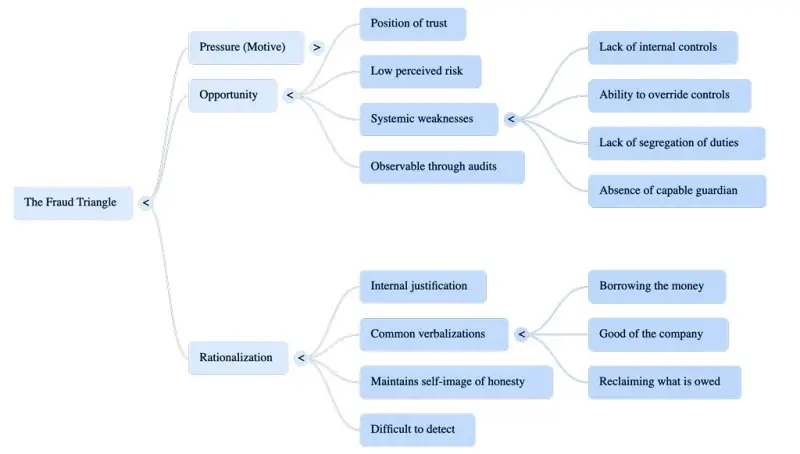
- Physical isolation: A state where the individual is isolated from people who can help, leaving them to solve their problems in secret.
- Status gaining: The classic habit of living beyond one's means to maintain a certain social standing.
- Employer-employee relations: Problems arising from an employer's unfair treatment, which may lead the employee to believe they are reclaiming what is rightfully theirs.
Opportunity is the "fuel" that allows the spread from the motive. When a person exploits a position of trust with a low risk of being caught. This typically stems from the ability to override existing controls of a vunerable target.
Rationalization
Because most fraudsters are first-time offenders who view themselves as honest, ordinary people, they must justify the act to themselves to maintain their integrity. They apply "verbalizations" to their conduct, such as convinced themselves they are merely "borrowing" the money, that the act is for the "good of the company," or that they are simply reclaiming what they are "owed" due to unfair treatment.
While auditors can often observe the Opportunity side of the triangle through system audits, Pressure and Rationalization are internal cognitive states that are notoriously difficult to detect until the "fraud" is already well underway.
Thank you, !
We are processing your request.
We will contact you at shortly.
Fraud Detection
Available Packages
TeleSign Fraud Prevention
TeleSign turns the phone number into a fraud detection powerhouse by mining intelligence from over 5...
HUMAN Security (White Ops)
HUMAN Security draws a hard line between authentic human traffic and everything pretending to be hum...
ZeroFox Digital Risk Protection
ZeroFox protects organizations in the digital spaces that traditional security tools were never buil...
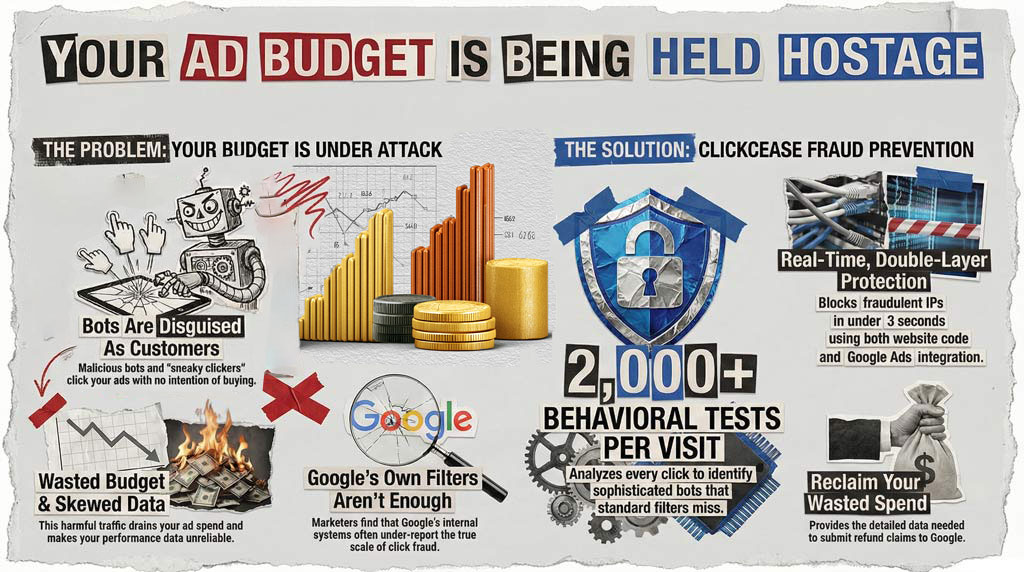
ClickCease
Protect your Google ads and websites with the best-in-class solution Block harmful traffic from wast...