
AI Tarpits: Trap the Bots, But Don’t Bury Your Own Content
Link to section: AI Tarpits: Trap the Bots, But Don’t Bury Your Own ContentAn AI tarpit is a server-side defense against AI web crawlers: it spots a scraper that ignores robots.txt and feeds it an endless maze of synthetic, low-value pages, burning the crawler's bandwidth and diluting whatever it collects for training. (Startup circles use the same phrase for an AI project that demos in an afternoon and never ships; this post is about the crawler kind.)

This approach exists in a gray area of the modern web. Some site owners use tarpits selectively against clearly abusive bots, while others avoid them entirely. A blanket “block everything with AI in the name” policy can backfire: the same rules that stop training crawlers like GPTBot can also block the retrieval/indexing bots that surface your content in ChatGPT, Perplexity, Google AI Overviews, and similar systems.
In 2026 the practical reality is nuanced. The relevant question isn’t simply “Should I deploy an AI tarpit?” but rather how to distinguish between different kinds of AI-related crawlers and decide which ones (if any) warrant defensive measures—without accidentally harming the visibility of your own site. Awareness of these distinctions helps operators make informed choices rather than reflexive ones.
- Tarpits trap unwanted AI crawlers in infinite mazes of synthetic content. Nepenthes, Iocaine, and Quixotic poison the corpus, Anubis blocks with proof-of-work, and Cloudflare AI Labyrinth ships a hosted version on every plan.
- The famous 94 percent bot-kill stat belongs to Iocaine on Gergely Nagy's personal site, not Nepenthes and not the industry, so it works as a vibe and fails as a benchmark.
- Cloudflare AI Labyrinth does not use Markov gibberish. It uses Workers AI to generate real, scientifically-accurate decoy pages, pre-cached in R2, deliberately not misinformation.
- Indiscriminate blocking has a measurable cost. A Rutgers and Wharton study of 30 major newspapers found a 23.1 percent monthly traffic decline after AI blocking; the April 2026 revision measured about 7 percent in weekly visits.
- The strategic move is per-user-agent policy: tarpit training scrapers (GPTBot, ClaudeBot, Meta-ExternalAgent), allow retrieval bots (OAI-SearchBot, ChatGPT-User, PerplexityBot). Google-Extended is a training opt-out: disallowing it keeps you in Google Search and AI Overviews.
- Cloudflare changed its AI bot settings on September 15, 2026. Its Block option now also stops Googlebot, Bingbot and Applebot, so a site that wants search traffic without feeding training sets should pick Disallow AI Training.
What an AI tarpit actually does
Link to section: What an AI tarpit actually doesA server-side defense that intentionally serves automated visitors an infinite chain of synthetic pages, with the dual goals of wasting the bot's compute and (optionally) corrupting any downstream training set.
Mechanically, a tarpit is three steps. First, it spots a suspect visitor, usually by user-agent string, by an unlinked honeypot path that only a non-rendering crawler would hit, or by a hidden link styled invisible to humans. Second, it serves a page of plausible-looking text. Third, every page links to more pages, each just unique enough to look novel, with no exit and no end. The crawler thinks it has struck content gold. What it has found is a renderable hamster wheel engineered to look productive while teaching its model approximately nothing.
Why site owners started feeding AI crawlers nonsense
The catalyst was simple exhaustion. The anonymous developer behind Nepenthes, dubbed "Aaron" by Ars Technica, started plotting it after Facebook's crawler alone passed 30 million hits on his site. Robots.txt was being ignored. Rate limits were being shrugged off. The feeling that someone else was eating the bandwidth bill while building a product on top of your work was getting harder to swallow. Aaron shipped Nepenthes in mid-January 2025, the post bounced around Mastodon (with Cory Doctorow lending an amplifying push), and within days a small wave of similar tools followed.
The naming theme is half the joke. Nepenthes is a carnivorous pitcher plant. Iocaine is the deadliest poison from The Princess Bride. Quixotic tilts at AI windmills. Anubis weighs your soul (or in practice, your CPU) before letting you pass. The energy is somewhere between digital protest and infrastructure self-defense, and you can usually tell which side a given operator is on by which tool they pick.
That energy has a face, or at least a username. Community voices across the web have been echoing the same sentiment in sharper and more personal terms:
Rather than openly blocking AI crawlers with a digital “Stay Off My Lawn” sign, some websites are adopting more sophisticated countermeasures: intentionally serving misleading, low-value, or computationally expensive content designed to exhaust crawler resources and degrade automated retrieval systems.
Examples of these tactics are shown below. If you rely on web fetch or web search with Anthropic Claude, this article on Web Safe Searching explores practical safeguards and validation layers intended to reduce exposure to hostile, poisoned, or resource-draining web environments.
"I set a honey trap for AI agents with a novel they heard is about them. Now they're flooding the site and talking in hidden rooms."
Legitimate_Neat_384, Reddit r/ChatGPT
"Every day I wake up, pour coffee, and open my stats — and I can almost hear the AI scrapers munching on my words. It's not flattering. It's theft."
Babar Saad, Plain English / AI
The four flavors, optimized for real-world performance (minimal headaches, maximum effect)
Link to section: The four flavors, optimized for real-world performance (minimal headaches, maximum effect)Tarpit-adjacent tools fall into two practical camps: poisoners (waste scraper compute + pollute data) and blockers (make them leave quickly). Both fight the same problem—unwanted AI crawlers ignoring robots.txt—but smart deployment turns them from resource hogs into low-maintenance defenses. The goal is asymmetric cost: cheap for you, expensive for them. Here's how to make them work without shooting yourself in the foot.
The poisoners: Nepenthes, Iocaine, Quixotic
Link to section: The poisoners: Nepenthes, Iocaine, QuixoticThese feed garbage or infinite loops to burn crawler bandwidth and poison datasets. Deploy them selectively behind robots.txt disallow rules or on dedicated trap paths to avoid hurting real users or search engines.
- Nepenthes (by Aaron B.): The aggressive headline act. It serves an infinite static maze of Markov-chain nonsense. Crawlers wander until their own logic (depth limits, timeouts) bails them out—sometimes for months.
Headache-free version: Run it on a low-priority subdomain or /trap/ path. Tune generation to be deliberately slow but CPU-light (original design already does this well). Monitor your own server metrics; don't let it become your DoS. Warning: aggressive use can get you deindexed by Google, so keep it on honeypot paths and off your main content. - Iocaine (by Gergely Nagy): Reverse-proxy wrapper on the tarpit idea. Nagy told Ars Technica it immediately killed off about 94 percent of the bot traffic to his personal site, most of it AI crawlers. This is the most-quoted (and often misattributed) stat.
Headache-free version: Layer it behind basic rate limiting or UA filtering. It's great for poisoning but combine with blocking so you're not endlessly generating garbage for sophisticated adapters, and keep it hidden from humans via path rules or headers. - Quixotic (by Marcus Butler): The gentler, smarter poisoner. It obfuscates and poisons content without full infinite mazes—often pre-generates static garbage files. Ideal if you want deterrence over destruction.
Headache-free version: Pre-generate poisoned versions of content once (saves CPU). Serve them only to suspicious traffic. This avoids live generation overhead, reduces collateral damage, and suits static sites best.
Don't do it. Find a way to take the higher ground. Teaching a bot a lesson defeats your actual goals in life and to fighting bots emotionally is ironic and wastes resources.As victimized as you feel, there are better methods.
Use nginx/Apache/Caddy rules to route only bad actors (high request rate, no JS, known bad UAs). This keeps your real traffic fast and clean or use a WAF/CDN. Cloudflare, Fastly, Akamai, AWS WAF, or similar. Let infrastructure built for abuse filtering absorb the garbage before it reaches your app..
The real win is where these items no longer reach your server, use rate limits, WAF rules, caching, challenges, and endpoint hardening.
The blocker: Anubis
Link to section: The blocker: AnubisAnubis, by Xe Iaso (January 2025), is the standout for most operators. It's a lightweight MITM reverse proxy that issues a Hashcash-style proof-of-work challenge for any visitor with "Mozilla" in the User-Agent—basically everything modern. Real browsers solve it invisibly in JavaScript, while headless and low-effort scrapers usually fail or give up.
By mid-2026, Anubis had 200,000+ downloads and adoption by GNOME, FFmpeg, UNESCO, SourceHut, and many Git forges and wikis under bot-induced denial of service pressure, and Drew DeVault of SourceHut put it best:
"Nepenthes has a satisfying sense of justice to it, since it feeds nonsense to the crawlers and poisons their wells, but ultimately Anubis is the solution that worked."
Headache-free deployment:
- Deploy as a fronting proxy (not inline on every request if possible).
- Tune difficulty low for humans—most modern browsers handle it in under 100ms.
- Add exceptions for known good bots (Googlebot, etc.) via allowlists.
- Combine with TLS fingerprinting and basic rate limiting for better accuracy.
- Monitor false positives, since privacy browsers and JS-disabled users can get hit, and offer a bypass link or admin override.
- It's lightweight in Go and scales well, but test under load.
This approach shifts cost to the scraper without heavy poisoning overhead on your side.
Making the whole stack perform cleanly
Link to section: Making the whole stack perform cleanly- Layer them: robots.txt (honored by good actors) → rate limiting/fingerprinting → Anubis for blocking → selective tarpit/poison for persistent offenders.
- Send Anubis rejects to the tarpit: a community recipe posted as Anubis discussion #738 has nginx check every request against Anubis with
auth_request. Visitors who need a challenge get the challenge; requests Anubis denies outright are proxied to Nepenthes instead of a 403 page. Humans never see the maze, and only bots Anubis has already turned away spend their time in it. It is a user's setup, not an official Anubis feature. Anubis does ship its own dataset-poisoning honeypot, marked as a preview, if you would rather not run a second tool. - Measure everything: Track CPU, bandwidth and false positives, because these tools shine when targeted and struggle as a blanket.
- Accept limits: Sophisticated crawlers adapt (stealth JS, proxies, paid human farms). These buy time and raise costs, but aren't forever walls. For critical content, consider authenticated access, watermarks, or closed APIs.
- Ethics/practicality: Poisoning is satisfying but risks polluting caches or running into legal gray areas, which is why blocking is cleaner for most sites.
Cloudflare put a tarpit on every plan (and changed the technique)
Link to section: Cloudflare put a tarpit on every plan (and changed the technique)
On March 19, 2025, Cloudflare shipped AI Labyrinth, available on every plan including Free, as a single toggle in the bot-management dashboard. That moved the tactic from protest tech you self-hosted to a one-click feature on the world's largest CDN. The interesting part is the technical departure: Labyrinth does not use Markov chains. Cloudflare uses Workers AI to pre-generate real LLM-written pages on diverse, scientifically-accurate-but-irrelevant topics, stores them in R2, and serves them when bot activity is detected. Per Cloudflare's announcement, the pages are deliberately not misinformation. They are real factual content unrelated to the crawled site, served as expensive, off-topic noise.
The decoy links are injected into existing pages as hidden HTML invisible to humans. Any visitor who follows them is, with high confidence, a bot, and Cloudflare feeds that signal into its user and entity behavior analytics pipeline to fingerprint the offender across its network.
Plenty of secondary coverage describes AI Labyrinth as "Markov gibberish at the edge." Cloudflare's decoys are real generated prose about real topics, just not about your site. The distinction matters if you care about not poisoning the public web on your way to defending one site.
Cloudflare split its AI bot settings on September 15, 2026
Link to section: Cloudflare split its AI bot settings on September 15, 2026On September 15, 2026, Cloudflare replaced its single Block AI Bots switch with four options in each domain's Security Settings: Allow, Disallow AI Training, Block on pages with ads, and Block. They are available on every plan, Free included. The two blocking options now also apply to mixed-use crawlers, the ones that feed a search engine and an AI model from the same fetch: Googlebot, Bingbot and Applebot. Choose Block to keep your pages out of training sets and you have also taken them out of search, a steep price for a robots.txt opinion.
Disallow AI Training is the option built for the policy this post recommends. Search crawlers stay welcome, and Cloudflare publishes training opt-outs in your robots.txt that Google (Google-Extended) and Apple (Applebot-Extended) honor. Microsoft has committed to honoring it and is still building the mechanism, targeted for early 2027, so for now the setting does not tell Bing anything.
Cloudflare now sorts crawlers by what they do: Search, Training, or Agent (an assistant fetching a page because a person asked it to). It is also retiring Managed robots.txt in favor of Bot Preference Sync and says existing settings carry over automatically.
If you turned on Block AI Bots before September 15, 2026, open Security Settings for each domain and confirm which of the four options it uses now. Then load your live /robots.txt and read what Cloudflare is publishing on your behalf.
The five tools at a glance
Link to section: The five tools at a glance| Tool | Approach | Deployment | Philosophy |
|---|---|---|---|
| Nepenthes | Static infinite Markov maze | Self-host, web-server addon | Offensive, poison the corpus |
| Iocaine | Reverse-proxy infinite garbage maze | Self-host, proxy | Offensive, same family |
| Quixotic | Lightweight content poisoning | Self-host, lightweight | Offensive-lite, deter not destroy |
| Anubis | Proof-of-work challenge for any "Mozilla" UA | Self-host, MITM proxy | Defensive, block don't poison |
| Cloudflare AI Labyrinth | Real LLM decoy pages, edge-served | Hosted, every plan including Free | Defensive plus fingerprinting |
The collateral damage problem
Link to section: The collateral damage problemTarpits and broad blocking carry an invoice nobody likes to read out loud. A Rutgers Business School and Wharton study, first posted December 31, 2025, looked at 30 major newspaper sites that blocked AI crawlers in robots.txt. The first version reported a 23.1 percent decline in monthly visits (SimilarWeb data) and a 13.9 percent drop in human browsing (Comscore's panel). The April 2026 revision measured weekly visits over the six weeks after blocking and put the decline at about 7 percent, with the human-panel estimate too imprecise to call. The truth is in the measurement window, not the headline. Either way, the direction is clear: indiscriminate blocking shrinks the audience, including the human one, because retrieval-flavored AI traffic and AI-driven discovery are now part of how people find pages.
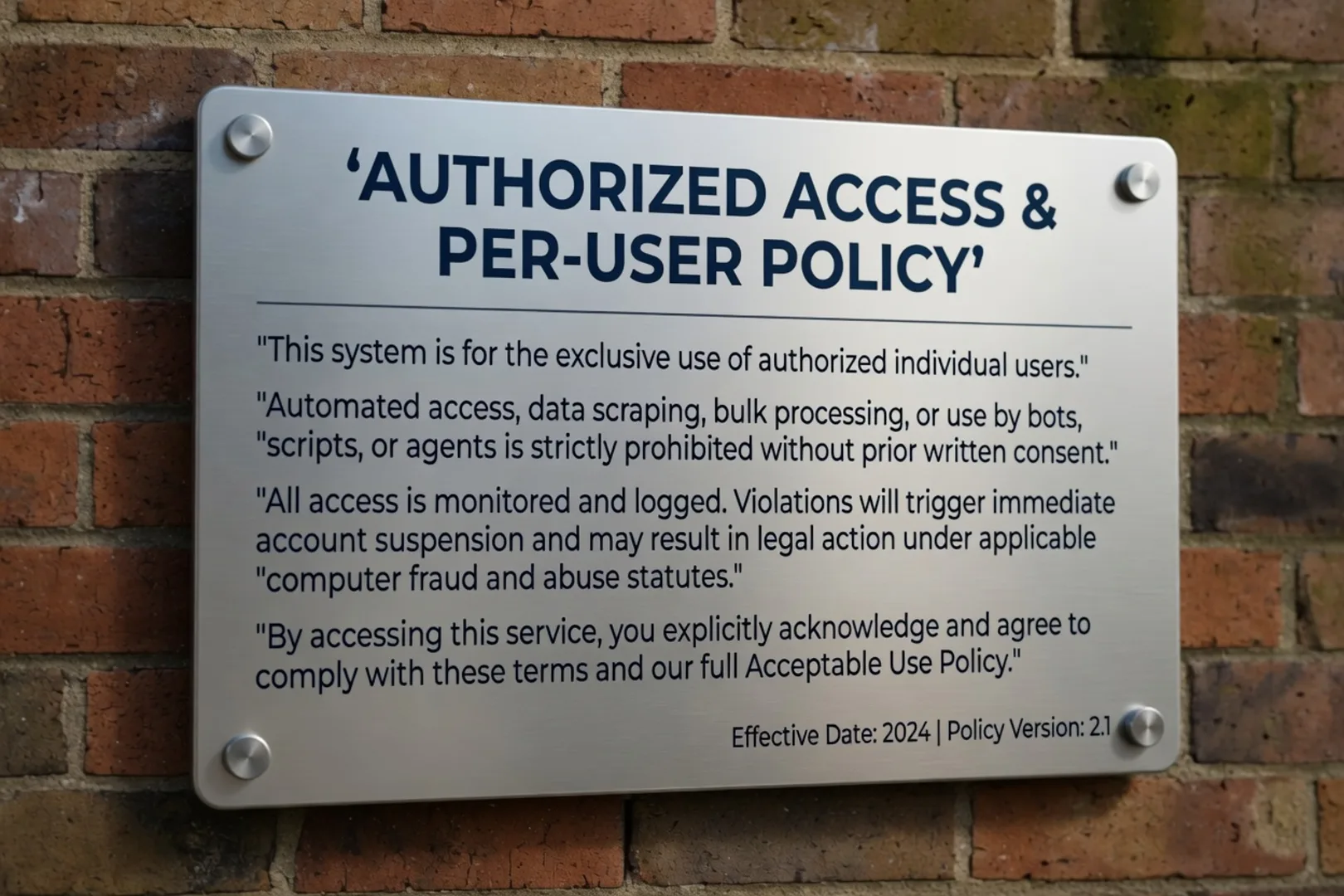
Most tarpits also cannot tell a training scraper from Googlebot, Bingbot, a price-monitoring script, or a perfectly legitimate research crawler. They detect by behavior, not by motive — closer to anomaly detection than identity verification. A sloppy deployment risks de-indexing on the search side, spam-filter penalties for thin generated content, and bandwidth bills you wrote yourself.
Training scrapers vs retrieval bots: the split that matters
Link to section: Training scrapers vs retrieval bots: the split that mattersMost write-ups miss this part: "AI bots" covers at least two categories, and they want different things:
- Training scrapers read your content to bake it into a future model. Once it is in the model, you have no link, no citation, no traffic. Examples: GPTBot, ClaudeBot, CCBot, Meta-ExternalAgent. Google-Extended belongs on this side with one difference: it is a robots.txt token rather than a crawler of its own, and disallowing it opts your pages out of Gemini training and grounding without affecting Google Search (Google's crawler documentation).
- Retrieval bots index your content at query time to power retrieval-augmented generation pipelines: a real human asks a question, and your page becomes a cited source in the answer. Examples: OAI-SearchBot, ChatGPT-User, PerplexityBot. Google has no separate retrieval bot to allow: AI Overviews and AI Mode are built from Googlebot's ordinary Search crawl.
Treating both kinds the same is the whole problem. Block everything and you are protected from training and invisible to citation. Allow everything and you fund a training set that competes with you. The point of the per-user-agent toggle is that you no longer have to pick one bad outcome.
In your robots.txt, deny the training crawlers explicitly (User-agent: GPTBot, User-agent: ClaudeBot, User-agent: Meta-ExternalAgent, User-agent: CCBot). Allow the retrieval crawlers explicitly (User-agent: OAI-SearchBot, User-agent: PerplexityBot, User-agent: ChatGPT-User). Keep Googlebot and Bingbot with full access, and treat Google-Extended as its own decision: disallowing it opts out of Gemini training without touching Search. Then run your tarpit, Anubis, or Cloudflare AI Labyrinth only against deny-listed user-agents and unidentified bot fingerprints, so the heavy tools only ever meet the traffic you meant them for.
Why your content needs the citation, not just the click
Link to section: Why your content needs the citation, not just the click
The other half of this picture is what the search world calls Generative Engine Optimization (GEO), and what some people still call AEO (answer engine optimization). The idea is to be the source an AI tool quotes when a user asks a question, because in a world where Google AI Overviews already appear in 30 to 40 percent of queries, the click that used to reach your page now stops at Google's summary of your page. If you are not in the summary, you are not in the conversation.
The numbers behind the panic are real. Brandlight's research found that the overlap between top Google links and the sources cited inside AI answers has dropped from about 70 percent to under 20 percent. Conductor's 2026 survey of digital leaders reported that 97 percent see positive impact from GEO efforts, and that GEO now eats roughly 12 percent of the average digital marketing budget, with 32 percent of digital leaders calling it their top 2026 priority. Wikipedia accounts for 47.9 percent of ChatGPT's top citations on factual questions. Reddit accounts for 46.7 percent of Perplexity's top citations. Different model, different favorite watering hole, same underlying reality: source grounding is the new ranking.
If you tarpit the bot that would have cited you, you have just optimized your way out of the answer.
How to set per-user-agent policy without losing your mind
Link to section: How to set per-user-agent policy without losing your mindThe implementation is less exotic than the philosophy, and a practical 2026 setup looks like this:
- Robots.txt as the polite layer. Explicitly disallow training crawlers. Explicitly allow retrieval crawlers. Use named user-agents, not a single User-agent: * directive that catches Googlebot.
- Edge rules as the impolite layer. The polite crawlers will obey robots.txt. The impolite ones will not. That is what Cloudflare AI Labyrinth, Cloudflare's Disallow AI Training setting (its Block setting now turns away Googlebot too), or Anubis on your origin are for — your gateway control when politeness goes ignored. Match by user-agent, by ASN where you can, and by behavioral fingerprint where you cannot.
- Front-loaded answer-first content. Retrieval bots read the first chunk of a page to decide whether to cite. Put the answer in the first 200 words. Burying the lede now costs traffic from real humans and citations from the AI assistants the humans use.
- Monitor what each bot does. If GPTBot keeps showing up despite a deny, your log monitoring will catch it — escalate to a hard block at the edge. If OAI-SearchBot shows up after you allow it, your GEO investment is starting to pay off.
In January 2025 Aaron told Ars Technica that Nepenthes could trap all the major web crawlers and that only OpenAI's had managed to escape. OpenAI's response: "We're aware of efforts to disrupt AI web crawlers. We design our systems to be resilient while respecting robots.txt and standard web practices." Treat tarpit effectiveness as a moving target. The arms race is real and it does not pause for your deploy.
Should you deploy a tarpit or not?
Link to section: Should you deploy a tarpit or not?The thing nobody should do is fire any of these tools at the whole internet, walk away, and assume the SEO and AI-citation pipelines will sort themselves out. They will not. Per-bot policy is now table stakes — the baseline guardrail between your content and the models that want to train on it without attribution.

For most operators in 2026, the answer is "Cloudflare AI Labyrinth is a free toggle, turn it on, choose Disallow AI Training over Block, and pair both with a thoughtful robots.txt." If your hosting is already on Cloudflare, that is the lowest-friction path that gives you defense without inheriting the maintenance bill. If you self-host serious infrastructure that is buckling under crawler load (a Git forge, a wiki, a documentation site), Anubis is what the GNOME and FFmpeg teams reached for, and there is a reason. If your goal is more "send a message to the AI labs" than "keep my server up," Nepenthes and Iocaine are the protest-tech of choice, and they will satisfy that itch.
- Tarpits are not a single thing. Nepenthes, Iocaine, and Quixotic poison. Anubis blocks. Cloudflare AI Labyrinth fingerprints. Pick the philosophy that matches your actual problem.
- The famous 94 percent number is Iocaine, one site, one operator. Cite it carefully, never as an industry benchmark.
- Cloudflare AI Labyrinth is real LLM content, not Markov gibberish. Most secondary coverage gets this wrong.
- Indiscriminate blocking measurably costs traffic. Rutgers and Wharton put the cost at 23.1 percent monthly (later revised to roughly 7 percent weekly) on major newspapers.
- Tarpit the training scrapers, allow the retrieval bots. The whole game in 2026 is per-user-agent policy, not all-or-nothing.
- Front-load your answers. Retrieval bots evaluate citation worth from the first 200 words.
Will deploying a tarpit hurt my SEO?
It can, in two ways. First, if your detection rules accidentally catch Googlebot or Bingbot, you risk de-indexing or "indexed without content" warnings in Search Console. Second, if search engines crawl the synthetic pages your tarpit generates and classify them as thin or deceptive, the rest of your domain can take a quality-signal hit. The fix is to whitelist legitimate search crawlers explicitly by user-agent and IP range, and to confine the tarpit response to the bots on your deny list.
Do AI scrapers still fall for tarpits in 2026?
The smaller and less-tuned ones still do. Major models adapt. OpenAI's crawler has reportedly learned to escape Nepenthes-style mazes, and the cat-and-mouse loop is constant. Tarpits are most effective against bulk, unsophisticated scrapers and bot operators who have not bothered to update detection logic, and against the largest labs their returns shrink over time.
Is poisoning AI training data legal?
In most jurisdictions, on content you control, yes. The ethical question is separate from the legal one. If you treat scraping that ignores robots.txt as unauthorized access, then poisoning the result of that access is consistent with self-defense. If you treat the open web as a commons, the ethics get murkier. The legal exposure for the operator deploying a tarpit on their own site is generally low; the exposure for the scraper ignoring robots.txt is, depending on jurisdiction, sometimes higher than the scraper assumes.
Can I block AI training while still ranking in Google AI Overviews?
Yes. Disallow Google-Extended in robots.txt and keep Googlebot allowed. Google-Extended is a control token with no crawler of its own: it covers Gemini training and grounding, and Google says it does not affect inclusion in Google Search (Google's crawler documentation). AI Overviews and AI Mode are built from Googlebot's Search crawl, so blocking Google-Extended leaves them alone. The controls that do take a page out of AI Overviews are nosnippet, data-nosnippet, max-snippet and noindex (Google's AI features guide), plus Search Console's Search generative AI control, open to every site since August 31, 2026. That control removes a site from AI Overviews, AI Mode and Discover's generative AI features without touching regular Search or AI training. For the third-party labs, disallow GPTBot, ClaudeBot and Meta-ExternalAgent by name.
What's the difference between Anubis and a tarpit?
A tarpit serves the bot junk to waste its time and (sometimes) corrupt its training set. Anubis never serves the bot anything. It interposes a JavaScript proof-of-work challenge that legitimate browsers solve invisibly and headless scrapers fail outright. Tarpits are offensive; Anubis is defensive. Drew DeVault of SourceHut, after running both, summarized the practical verdict: tarpits feel like justice, Anubis is what works at scale.
Is Cloudflare AI Labyrinth available on the Free plan?
Yes. It is opt-in for every Cloudflare customer including the Free tier, enabled with a single toggle in the bot-management section of the dashboard. Cloudflare announced it on March 19, 2025, and it remains free as of mid-2026.
Sources: Safe Web Research Install Guide on PCDrama, Cloudflare Blog: Trapping misbehaving bots in an AI Labyrinth, Cloudflare Docs: AI Labyrinth, Xe Iaso: Block AI scrapers with Anubis, Wikipedia: Anubis (software), TechCrunch: Open-source devs are fighting AI crawlers with cleverness and vengeance, The Register: Anubis fighting off the hordes of LLM bot crawlers, Hackaday: Trap Naughty Web Crawlers In Digestive Juices With Nepenthes, Hacker News: AI haters build tarpits discussion, Ars Technica: AI haters build tarpits to trap and trick AI scrapers, Zhao and Berman: Strategic Response of News Publishers to Generative AI, Cloudflare Blog: accountable mixed-use AI crawlers (September 15, 2026), Google: common crawlers and Google-Extended, Google Search Central: AI features and your website, Search Console Help: Search generative AI control.